9/5/14

Family Time


Though this full moon doesn't quite have the chimerical island effect (from rising over the palm trees and silver lagoon), rising over the faleo’o, even in the good ol’ USA, still comes close.  LOL!!!  Relaxing after a family backyard barbecue.

some of the g/kids "playing" with fire ... and roasting marshmallows in the backyard
... making s'mores on a cool Fall evening, ideal night to sleep in the faleo'o... :)

8/26/14

O le Faafetai ...

 ... sa tuuina i le ‘auvala’aulia o le fiafia sa faia mo Elder Letalu (Aukuso 26, 2014), i lona taliu mai i lana misiona
________________________________

Oute manatu o le a le tu’ua faa-mafutaga tafatafamaogo le tatou afiafi.  O upu masani fo’i a le atunu’u e ui ina faapopo aso ua a’o aso folau e le mafai ona tu’ua. O lona uiga poo a ni porokalama fuafuaina ma faataatia, e masani ona iai ni suiga e faapopo ma faafuase’i, ae e iai fo’i tulaga e le mafai ona suia pe soloia.

E faapena fo’i la i nisi o tulaga o le tatou tu ma agaifanua, ae maise le faaleoina o se loto ma se agaga faafetai mo se faaaloalo. O le pogai lea o lo’u toe soso atu, e pei ona tuuina atu i le taimi ua sola.


E le o toe na ma le laina, ua malama fo’i i ulugalu, O le to’atele o lo tou pa’ia ma lo tou mamalu ia o ni aiga ia i ma’ua ma le tina.  Ae a lafalafa fo’i tuga, ua aiga e tasi i tatou uma i le Tala Lelei, lea ua mafua ai ona tatou penei, e patipatia le ta'avaoga ma le ta'aseega i le Tala’iga a le atali’i. 


Peita’i, e ui fo’i i so tatou  soo tulutulu ma faafaleve’a i lo tatou va nonofo, ae e le tuua ai i lalo o outou pa’ia ma outou sa - paia o aiga, nuu ma alalafaga, aua o le tagata ma lona tupuaga o le tagata foi ma lona faasinomaga.  O lea, ta’oto faa-galu e le fati o outou sa ma faiga, ae maise ia te outou o ni o’u paolo ma faamalumaluga, ni o’u sao i malo.  Tulou.


Faatulou atu fo’i i auauna a le Atua faapea tupu ma tamali'i ua tatou faatasi, i o outou sa faale-Talalelei ma mamalu faale-atunuu.


O pa’ia o Samoa, ia o le a faase’etuagalu; e le gafataulimaina e lo’u tagata ona taea pa’ia ia, ae le gata i lea, o loo iai laoa, maota ma malae o Samoa e agatonu ai pa’ia ia. Ae ta faapei ia o le upu nai Poutoa, ia taoama pa’ia ia ae lafo i matau le faatofala’iga aua le Atua ma lona finagalo.  Lea e iai le aso.


Ae o le a se’i  ta’utino le solo a le tamaloa, ma ou faapea atu - Faafetai, faafetai, faafetai tele lava.


Faafetai atu i lo tou maliu mai ma afifio mai. Faafetai i lo tou faamalo’ulo’u lo tou tutu la’au faamanuiti, ma lo tou taliaina aloa’ia o le valaau  ma le faatalau’ula atu a i ma’ua ma le fanau.  O lea ua maualuga ai le aso ona o lo tou amana'ia o le talo atu.


E le faagaloina  fo'i faai’a i ola lo outou agalelei.  E le ufiufia foi faamanugase lo tou alofa ma la tou foa’i,  i soo lava se tulaga. Poo tupe, poo taumafa poo nisi lava faatinoga, ia toe faafetai ma faamalo atu.  O ai le tagata ua e manatu ane ai? O upu masani, ia e sili le manuia o le foa’i nai le talia.  Ia sautualasi ona faamanuia atu le Atua.


E talitonu fo’i le faamoemoe sa outou tagi ma faasagi i le Tama i le Lagi aua le manuia ma le saogalemu o ana auauna tala’i o ali’i ma tama’ita’i o loo tala faauto i itu e fia o le kelope, e aofia ai ma le atali’i lea. Faamalo ma faafetai i a outou faatoga ma talotaloga, ia outou tagisaga ma talosaga.


Ou te le toe tau selu pe faalalanu atu. E le toe tau ‘aufagaina fo'i le la’au ua ta tulaga. E iloa le tamali’i i ana taga o le tupu fo’i i ana aga.  


Ona faata’i lea ma se matou tala, afai ua le so’o lou pale le tau lou titi, ia malu ave i fale i outou finagalo se taumafaiga vaivai a Letalu ma le aiga.  Ua pu’upu’u si ota lima.  Ae o le auganiga, ‘aua ne’i lia’iina i ala sota faatamala. Ia lililo fo'i faiva o Fiti.  O se upu fo’i ua le tau tamali’i, ia alofa ma ia va'atele i outou finagalo. 


Ia o si a'u toe pi'ioa atu lea i le ta aleaga i lenei afiafi.  Sau se taimi tatou taumavae, ia alofa le Atua e puipui ma leoleo le toe taliu atu i aiga ma fanua. Tatou mavae lea i le mavaega nai le tai, a Taema ma Tilafaiga - Pe a ta fefulituaa’i, ia tumau lo ta fealofani.


Ia soifua ma ia manuia.

8/11/14

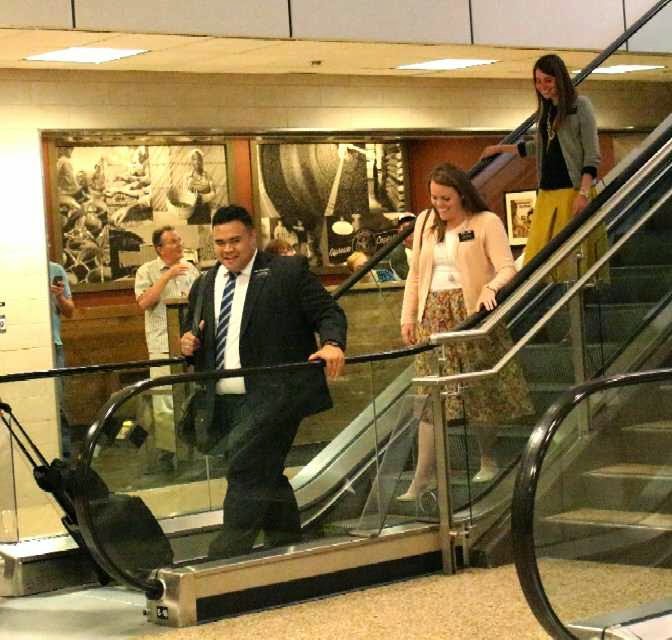
He's Home!


The Arrival...

Dearie and I, among many who also waited for their sons and daughters
returning from missions around the world.

Elder "L"... anxious to meet his Mom for the first time in two years

... bag off and on its way to the floor, and running

... to hug his Mom

...with Mom

... and Dad


... with oldest nephew (grandson), who should be our next "Elder" - in a year's time?
...we have the leis, the aloha spirit, so why not the sign, aye?

...with Mom, Dad and sisters


The Party ...

The Band serenading -"Ita e, ua lili'a..."
"NC" - North Carolina (Charlotte) Mission
... some of the nephews and future missionaries getting ready to perform for Uncle Elder "L"


... Saaaaauni!!!!! (Ready!)

... jammin'


... the "girls"/nieces after the performance

... the group after the show

... with the performers (nieces and nephews) after the the party
... with "sisters" missionaries

... father and son

SUP??


WussssssSUP?   Well, it’s SUP - Stand Up Paddleboarding ..that’s wussssup!!! ..lol!

Some of our children who were kayaking and paddleboarding last weekend at the lake invited us (Dearie and I) to come hang out.  I wasn’t in the mood of getting wet or doing anything in the water.  I just wanted to sit, relax, enjoy and appreciate nature and watch some of the grandchildren play and swim.  And  then I got bored - hmmm...a little. So I said “why not?”  I couldn't resist getting on the stand up paddleboard; I got on and paddled out to the middle of the lake.

Paddleboarding actually was invented by Polynesians, namely the Hawaiians who would lie (not "lay", Americans ... lol) on the stomach (prone) on the board and paddle with their hands. SUP is a variant of paddleboarding.

Balancing was a challenge especially when the rippling waves, cranked up by the passing waverunners and boats, rocked the paddleboard. Heheee ...

So while SUPing, the connection with my island roots and life was inevitable and immediate.  I remember, as a teenager, paddling the paopao (dugout canoe) standing up, most of the time during folaulauga (leisure canoeing).  The nostalgia was refined and near poignant as some of the songs came to mind:

“Aloalo malie lou va’a Samoa, i lou sami lanumoana ...” and

“A e fia tafao toso lou paopao, 
pei oe se seila mai nu'u mamao
e te  folaulau ai ma e lagilagi pese 
ma e faalogo i le tausagi o manulele.
Samoa e, ou te alofa tele ia te ‘oe ....”  

Hey, it’s Summertime, Summertime, Sum Sum Summertime!!


6/26/14

A Matai (chief) is supposed to lead, preside and ........ SERVE!

Public servants serving badly

This post is inspired by a recent editorial in the Samoa Observer titled “We need public servants, not public lords.”  The title is self explanatory especially to anyone who understands the present problem (in Samoa) of “public servants [abusing] their power, showing blatant disregard to the very people they are employed to serve,” which, in effect, sums up the finding of a report recently released by a Government committee.

The behavior and pattern - of public servants behaving and acting like public lords - is a universal one.  It’s a vice among some.  And though there are similarities in its origins and manifestation in different cultures and societies, some cultures experience and perpetrate the problem in their own unique ways and patented methods.  Samoa is a good example.

Let me theorize on a couple of reasons for the seeming prevalence of this contagion in Samoa.

1. First, the primary cause may be rooted in the culture and traditions.  Samoa, traditionally, has a rank and status-based culture. The native expression “O Samoa ua uma ona tofi” (“Samoa has been classified”) is a reminder of the status and rank demarcations within the socio-political and religious lives of the people. Samoan society is therefore highly stratified.  Within this stratification we find a trident that proves detrimental, at least to public service in the country.

First, in the traditional system (which is still alive and well), there are the “royals” - “kings” and “kingly families”, nobles, matai (chiefs), paramount chiefs, taupou (daughter/s of chiefs), manaia (son/s of chiefs), faletua and tausi (chiefs’ wives) - and then the commoners.
Second, in the modern sector, there are government posts (PM, MP’s, Ministers, Associate Ministers, CEO’s, CFO’s, COO’s and all other “O’s” out there) middle management managers and supervisors, etc., and then the rank and file employees.
Third, adding to the above mix, is the religious prong consisting of the clergy (church callings such as pastors, ministers, deacons, lay pastors, etc.).

The trident becomes an instrument of entitlements, privilege and honor, and is often addressed during introductions of public speeches and traditional oratory, as mamalu faale-talalelei (religious honors), mamalu faale-malo (governmental honors) and mamalu faale-atunu’u (traditional/cultural honors).

This means, for example, that it’s possible for a government official (e.g. a Minister) to possess concurrently the prestige and honors of a government minister, a traditional chief and/or a clergyman (e.g. a deacon). Unfortunately, with this triple endowment, the penchant and obligation to serve become secondary if not completely abhorred.  The government official views himself more as a head honcho and big boss. In another culture, place and time this public servant/employee would maybe do the honorable thing of serving than be served.  However, in Samoa, where the ala i le pule o le tautua (path to chieftainship is through service) is still the norm, this person/matai will think that his servitude years are done.  Now that he’s a matai, he feels that he’s made it to the top of the proverbial socio-political ladder and it’s time for him to reap and enjoy the rewards and entitlements.

Again, the seeming hesitation to serve is sustained more by the public servant's traditional matai status than the other two (government and religion). So, although the religious and government positions/callings typically predispose him to serve, being a matai/titleholder often becomes a convenient contrariety.  And even with today’s trending shift of the role of the matai to serve, than the traditional one of being served, old habits certainly die hard with these chiefs.  The problem is only compounded by a law passed last year that all Members of Parliament are required to hold a traditional chiefly title to be a legal and bonafide legislator.  A matai title serves as an official validation for one’s position.  In other words a title and role of a CEO, a Minister, Associate Minister, manager or supervisor mean very little within Samoan society without a concurrent matai title. Hence, as a social, political and business norm (not so much the religious), you find that these higher-uppers have matai titles.  They may be bestowed as honors by their aiga (family) but they’re also validation stamps for their other more modern titles and positions.

The editorial presents this scenario about serving first and status and honors after..

“For example, if you’re the son of the king but your job is to clean the bathroom, well you are not there as the king’s son, are you?”

I agree. His status as a king’s son should not be portable and/or ubiquitous. In the Samoa context, however, as a “king’s” untitled son (without matai title), chances are that he may and still will clean bathrooms. But give him a matai title and he will be a different and transformed person. With the title, he gets a promotion. He is a kahuna. A big fish. A fish too big for the septic tank. He will not clean any more bathrooms.  O Samoa ua uma ona tofi, and a matai is not supposed to clean bathrooms. So, in essence, a matai title (in Samoa more so than abroad) is a potent emancipation and freedom pill.  Freedom from most obligations including and especially serving.

2. Besides this classified and stratified character of Samoa’s traditional society, the status and honor mentality stemming from Samoans’ near obsession with royal lineage and affiliation (aiga/gafa tautupu) may also have something to do with the lordly  reluctance to serve.  What I mean is that Samoans, as individuals and as families, have this proclivity of tracing their gafa (genealogy) to one of the royal families, if not THE royal family.  (This behavior is rather common among Samoans living abroad where their lineages may not be immediately known and understood or scrutinized.)  As a result, Samoans often inhale and exhale the aroma of nobility and wear the royal halos and therefore insist on being served than to serve. So it is not uncommon for a receptionist to subconsciously recite her lineage as the daughter of Oa’uekupugamaikupua’ooukouumaoisumu and then continues to play Solitaire while an old man of the lower pecking order from kuaback keeps waiting to see the manager (who is also a matai) or be told that he is at a very important meeting, when he’s actually playing Solitaire too in his $600K office.

This lordliness and wannabe attitude among the people gives rise to the pervasive expression and notion of “fia tagata/kagaka” (giving off the attitude of being high and mighty) and possibly to the trendy counterpunch “E le valea fo’i gei fagau” (These children/descendants are not stupid.)   But then I wonder if the latter expression can also be used to justify and rationalize the reluctance to serve.  When some people commit to serving continually while others don’t, the former may get to the point where they would say “Oh we’re not stupid to keep on serving while others just want to be public lords and lordly lords!” LOL!!  Sa’o a?  Ia ‘aua ne’i musua e fai mea lelei ma mea tonu. Auauna pea ma le alofa.

So when a public servant develops an attitude of neglecting/ignoring his/her responsibilities - or being reluctant - to serve, it's usually because he/she feels that he/she has moved up to a royal class (through chieftainship) or has hereditary royal blood.

Funny that as I was writing this post, in the back of my mind were the following lyrics from the refrain of the current hit by one of my favorite contemporary singers, Lorde (pun not intended):

[That] we'll never be royals
It don't run in our blood
That kind of luxe just ain't for us.

Ia fika ifo ia e ‘oe!  :)

6/9/14

RIP John Atherton

John Atherton (Samoa Observer photo)
I just read in the Samoa Observer that Mr/Dr. John Atherton has passed on.  Although I don’t know him personally, I have been a fan and an admirer of his writings to the Observer, and based on those writings, I agree with his wife’s testimony that
[John] was a great writer and thinker .... He has read the different religious books, Koran, Mormon, teaching of Buddha and read the Bible three times. [He] read all the religious books for understanding and deeper meaning of the soul. He was in search of his view of God.  He would write about local politics, philosophy particularly comparative religion.
John definitely seemed a well-read man, especially on religion. At one time, four years ago, he posted a few fair, valid and stimulating questions/issues in the Observer (Letters to the Editor) to which I responded.  I have re-posted his questions and my responses verbatim (versus links) below.
Ia manuia le malaga John.  I have no doubt you will find the gospel and answers to your questions on religion and on the “deeper meaning of the soul” in the Spirit World.
------------------------------------------

Free Will and Morality

Mr. Atherton:
Morals do not begin or end with the Bible. Neither the Bible nor Christianity has a monopoly on morality. Several moral codes have been developed over the years by civilisations unfamiliar with Judeo-Christian scripture.

LV:
God predates all these sources including the Bible. His Spirit was in the beginning; He was in the beginning. His “light” enlightens and elucidates every man and creature.  Morals begin and end with God - the Alpha and Omega.

Mr. Atherton: 
But here is a question for those of your readers more knowledgeable about these matters than I am: if God intended humans to be moral, why did He forbid Adam and Eve to eat the fruit of the tree of knowledge between good and evil?

LV:
I don’t claim to be more knowledgeable about matters raised by Mr. Atherton. I do however have some idea of what he’s enquiring about and I hope my insights will at least shed some light on the issue(s). My answer lies in Free Will and its indubitable link to morals and morality.

Free Will is a broad and complex subject and has become more convoluted, if not more controversial in recent decades. New fields and disciplines such as neuroscience, cognitive psychology and even new branches of the prototypical fields - philosophy and theology - all subscribe and contribute to the discourse and disputations. Because of such complexity, I will try to limit my response to the Biblical context as mentioned in the question.

Free Will - in its connotation of agency of man or freedom to choose between good and evil - was granted to Adam and Eve in the Garden of Eden. It’s true that they were forbidden to eat of the fruit of the tree of knowledge of good and evil, BUT, along with the interdiction, Adam and Eve were allowed and given the freedom to “choose”.  In the LDS canon, we find this clear specific consignment of the freedom to choose by God to Adam and Eve:

“But of the tree of the knowledge of good and evil, thou shalt not eat of it, nevertheless, thou mayest choose for thyself, for it is given unto thee; but, remember that I forbid it, for in the day thou eatest thereof thou shalt surely die.” (Moses 3:17  Emphasis mine)

Now before any accusatory scream of heresy is launched and fired, it is well to understand the Bible itself, since it does basically say the same thing - that Adam and Eve were given the freedom to choose. Let’s examine the applicable verses.

“And the Lord God commanded the man, saying, Of every tree of the garden thou mayest freely eat: But of the tree of the knowledge of good and evil, thou shalt not eat of it: for in the day that thou eatest thereof thou shalt surely die.” (Genesis 2:16,17 - KJV)

God is essentially - and in a real subtle yet compendious way - saying: “You can do this, BUT not this.”  That’s CHOICE right there!  In other words, God gave them a choice between two opposite alternatives. Alternatives along with clear and specific consequences also suggest succinctly the possibility, opportunity and ability to choose as individuals.

Again, Adam and Eve were forbidden but were also given the freedom to choose which is tied to our ability to make moral choices.

On a bantering note, I wonder if God was punning when He said to Adam and Eve that they may “'freely' eat”.

LV Letalu
_______________________________________________

Beasts, creeping things and birds.

"The reason God [blotted out man, beast, creeping things and birds with the Flood] was because the people were wicked.  But does anyone know where the beasts, creeping things and birds went wrong?" - John Atherton, Siusega.

If I surmise correctly, the assumption made by Mr. Atherton was that the beasts, creeping things and birds were not wicked, but innocent and therefore should have been vindicated.

His question therefore is a thought-provoking one; though to any diehard religionist, it’s an easy one that can be answered with this familiar, convenient, one-size-fits-all and pat response: "It’s God’s will."  Inevitably, in the end, it may very well be "the answer", as it is for most other Biblical mysteries and/or faith-based conundrums. In that case, I may be guilty of making a circular argument in my reply.

Nonetheless, for curiosity and fecundity’s sake, I think the question deserves ruminating and cogitating over. So here’s my take, not as a freethinker but as a free thinker.

I am going to start my supposition with a popular quote by the Greek philosopher Protagoras that "Man is the measure of all things." Generally, this quote has been handed down with no clear or concrete interpretation, although it is oftentimes linked to agnostic and relativistic contexts in which man - not God - is purported to be the ultimate source of morals and values.

Within such vagueness and speculation - as well as in an attempt to answer Mr. Atherton’s question - I would take the liberty in rephrasing Protagoras that "Man is the measure of all things [God created]." The insertion of God, I hope, clears up the ambiguity and the obvious irony established by the godless context of the original quote.

As believers in God, we understand that man is the epitome or crown - hence "measure" - of all of God’s creations. Therefore he was given the charge to be "lord" over all the earth:

"And God said, Let us make man in our image,... and let them have dominion over the fish of the sea, and over the fowl of the air, and over the cattle, and over all the earth, and over every creeping thing that creepeth upon the earth." (Genesis 1:26).

With that as a premise, here are the two probable reasons for the seeming unfairness on the part of God in condemning and cursing the beasts, creeping things, birds, etc., - again, as assumed by Mr. Atherton.

1. Beasts Creeping Things and Birds as Accomplices and Cohorts.
The influence of man as being the measure of all things created, can have a far reaching effect that even the animals become evil in their own way when man - as master and measure - himself becomes irreparably evil and his cup of iniquity is full. In other words, when man becomes evil continually and is found lacking in all of God’s attributes (love, patience, compassion, etc.,) he tends to treat the animals, birds, and creeping things unkindly. This in turn can make the animals more ferocious, vicious and hostile against man and against each other. Once I quoted this saying that "even a dog knows the difference between being kicked and being stumbled over."

This overall deterioration and degeneracy can be transmissible to the point that a comprehensive and universal moral pandemic becomes a precursor to, and harbinger for, the condition of ripening in iniquity that would, in turn, prompt God’s wrath and vengeance upon all - man and beast. The destruction of Sodom, Gomorrah and other cities of the plains is a good example.

Another example is found in the book of Jonah.  God commanded Jonah to preach repentance to the city of Nineveh whose inhabitants had become exceedingly wicked and evil.  The king and his nobles then decreed man and beast to fast and repent, and turn from their evil ways (Jonah 3:7-8).

In this first part, I’m suggesting that it’s quite possible for beast, creeping things and birds to sink to a degenerate condition - within their own sphere for the most part - from the ripple effect of man’s own wicked condition. Accordingly, God would therefore see fit to blot out man and his subordinate cohorts. Man should not underestimate his influence - moral and otherwise - on the totality of his environment.

2. Beasts, Creeping Things and Birds as Inclusive Collateral.
The act of God on the beasts, birds and creeping things is to exact (pun intended) punishment on mankind. In the Bible, God allows deserving, indiscriminate and annihilative punishment only when a people, again, ripens in iniquity - not at the very first incident or episode of evildoing. From Genesis 6:5, this clearly was the case in Noah’s day - that the people were evil continually in their hearts and minds, hence deeds as well:

"And God saw that the wickedness of man was great in the earth, and that every imagination of the thoughts of his heart was only evil continually."

So if everything (animals, birds, etc.,) was created by God for man’s benefit and welfare, then it would seem appropriate to have them recanted and eradicated too along with man - if not to impose further and fair punishment, it can also be an intrinsic part of God’s inclusive collateral and compensatory system. The concept could be akin to the modern legal precedent where the guilty party is required to sell or surrender his/her property in order to satisfy a court judgment/settlement.

The belief in the harmony/unity of man and nature - as one indivisible whole - may also be used by some to explain the same concept of inclusive collateral. In fact, the trickle down and contiguous effects of man’s evildoing that include his environment and other living things are neither farfetched nor impractical.

Take the Fall (of Adam) for example. When Adam fell, everything (animals, plants - in essence the whole earth) fell. The ground was cursed with thistles and thorns and the serpent was "cursed above every beast of the field." This means that other beasts were cursed too with the serpent being cursed above all of them.

Further, as stated, the ground was cursed for man’s sake (Genesis 3:17). The point here being that the effects of man’s disobedience extend far beyond himself.  In the book of Zephaniah - prophesying about Judah’s fate - we get this all-inclusive reach of God’s cataclysmic hand as a result of man’s vile and abominable sinfulness.

"I will utterly consume all things from off the land, saith the Lord. I will consume man and beast; I will consume the fowls of the heaven, and the fishes of the sea, and the stumblingblocks with the wicked; and I will cut off man from off the land, saith the Lord."  (Zephaniah 1:2-3 Emphasis mine).

Again, indiscriminate, widespread and utter destruction is part of God’s judgment on mankind when their cup of iniquity is full.  The Flood was such an incident and event.

In a sense, also, we can view the Flood as a cleansing act of God in order for the earth to comply and conform to His pure and unblemished nature and character, or at least His will for His children.

LV Letalu